

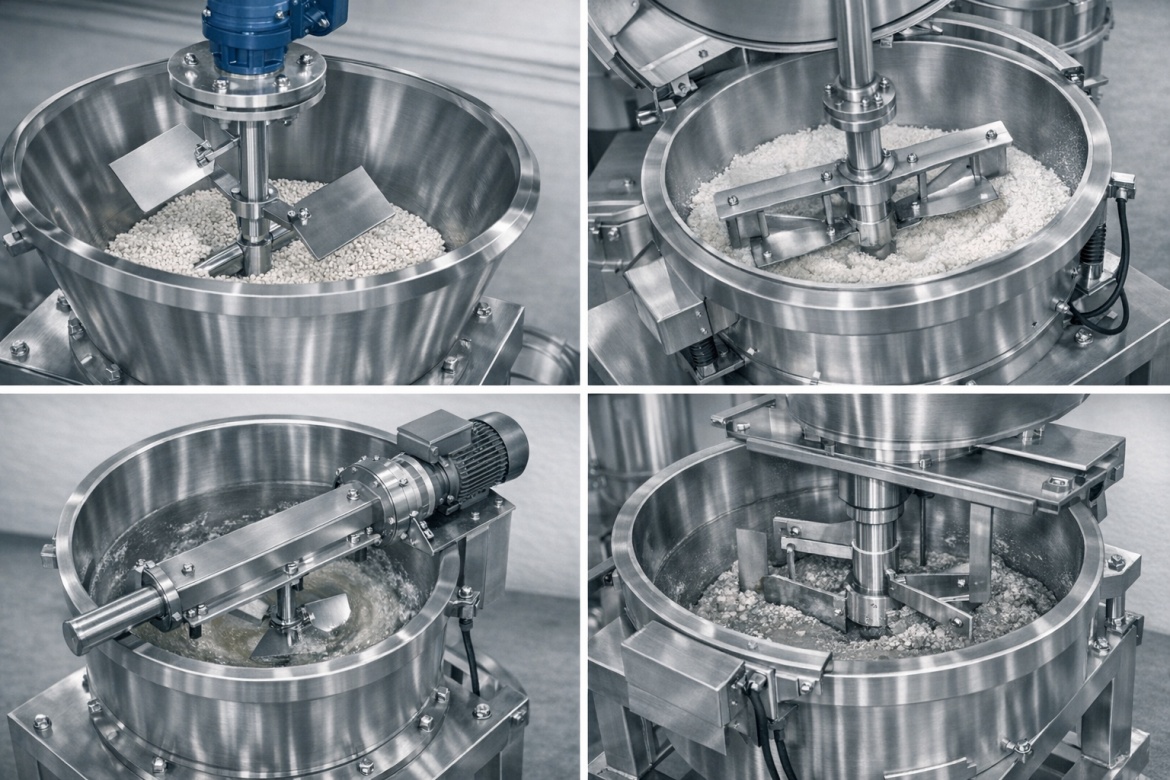
Customised Dosing Solutions with Screw Feeders for Bulk Material Processes
Efficient production processes depend critically on the precision and reliability of dosing technology, especially when handling a wide variety of bulk materials. These materials range from free-flowing powders to poorly flowing, sticky, or even coarse-grained media. In such applications, innovative screw feeders are indispensable, ensuring controlled feeding and accurate dosing—a key factor for product quality and process efficiency throughout the value chain.
Needs-Based Engineering for Maximum Process Safety
- Customised dosing technology designed for each material, capacity and precision requirement
- Combination of coarse and fine dosing with twin or combination screws for ultimate accuracy
- Specially engineered geometries for problematic bulk material properties
- Product loss minimised through targeted adaptation
Screw Feeders: Versatile All-Rounders for Every Application
Screw feeders serve as the backbone of modern bulk material dosing systems. Their operating principle is based on a rotating feed screw, whose design is optimised for each process requirement. Depending on material flow behaviour and required throughput rates, either single-screw or twin-screw systems are applied. The latter enable both coarse and fine dosing, thus providing high dosing rates with uncompromising accuracy.
Innovative solutions combine various geometries and materials. Even challenging substances, such as fibrous or highly compacted materials, can be dosed with high reliability. Optimised discharge geometries prevent bridging and caking within the unit, providing a steady and controllable material flow.
Modular design concepts offer further benefits: exchangeable screw units and flexible interfaces to control systems ensure dosing solutions are adaptable and easy to maintain. Industry users thus benefit from investment security in sectors such as chemicals, food processing, and rubber manufacturing.
Smart Integration: Precision Meets Efficiency in Process Automation
Integrating screw feeders into automated process lines unlocks significant potential. Precise coordination with weighing and control systems reduces product losses and ensures traceability. Modern drives allow for dynamic adaptation of dosing speed as needed by the process.
In combination with gravimetric or volumetric weighing cells, even very strict dosing tolerances are reliably maintained. If required, ATEX-compliant designs are possible for use in explosion-hazardous areas. Advanced software monitors all relevant parameters and provides intuitive visualisation. Seamless, future-proof integration into existing production environments is achieved.
Best Practice: Dosing Systems for Challenging Materials and Complex Plants
Industrial applications—such as the processing of additives, fillers, or pigments—demand comprehensive expertise in plant engineering. Each raw material, whether free-flowing, hygroscopic, or abrasive, poses unique requirements. Experienced plant builders devise custom solutions, accommodating essential process requirements for feed rate and accuracy while optimally integrating with existing process interfaces.
When integrating into established plant infrastructures, supplying just a single machine is not sufficient. Complete process chains must be made functional and investment-secure. Proven twin-screw and combination systems provide maximum control over critical parameters and guarantee consistent product quality with maximum plant availability.
Future Trends in Dosing Technology: Sustainability and Digitalisation
Developments in dosing systems for bulk materials are increasingly shaped by digitalisation and sustainable business practices. Energy-efficient drives, smart sensors, and adaptive controls maximise resource use while increasing safety and transparency. By analysing process data, systems can be continuously optimised—from extended maintenance intervals through to fully automated process management.
Sustainability is gaining importance: precise dosing avoids overdosing and waste, bringing both economic and ecological benefits. The customisation of screw feeders helps industrial operations to shrink their environmental footprint in the long term.