

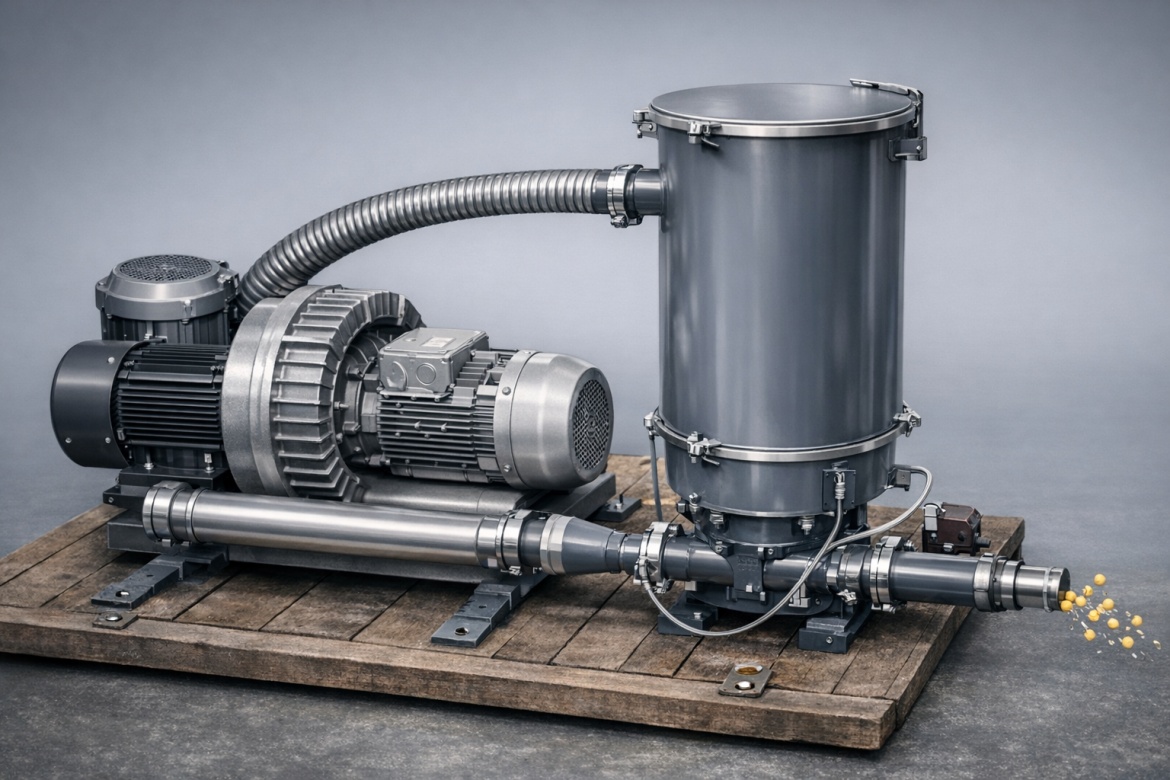
Pneumatic Conveying Systems: Comprehensive Approaches for Protecting Sensitive Products
Pneumatic conveying technology has become a central pillar in modern industrial processes. Especially when sensitive bulk materials need to be transported automatically in large quantities, companies face a crucial challenge: How can goods arrive at their destination efficiently and undamaged? The focus is not only on speed but above all on preserving product quality. Minimizing product degradation during transport has become a decisive competitive factor.
The Basics of Pneumatic Conveying
- Pneumatic conveying uses air streams to move bulk materials through pipelines.
- A key distinction is made between dilute phase (lean phase) and dense phase conveying.
- Both systems offer specific benefits and challenges, particularly regarding product integrity and energy efficiency.
Dilute Phase Conveying: Efficient but Demanding for Sensitive Products
In dilute phase conveying, particles are moved at high speed through the pipeline. This process allows for continuous material flow and high throughput. However, the dynamic movement increases the risk of abrasive wear and product degradation—particularly for fragile or abrasive materials, quality may suffer. Dilute phase conveying is thus best suited to robust bulk goods or processes where minor material losses are acceptable.
It is increasingly clear across industries that maximizing throughput alone is not sufficient. Comprehensive planning needs to account for both the conveying parameters and the unique properties of the material being transported.
Dense Phase Conveying: Tailored Solutions for Fragile Materials
For products requiring particularly gentle handling, dense phase conveying provides key advantages. With a lower air ratio and slower, pulsed movement, shocks, friction, and collisions are minimized. This enables careful transport of sensitive foods, granulates, pellets, or crumbly substances with little to no damage.
Another benefit lies in reduced energy consumption and lower dust emissions. However, dense phase systems require precise design and sophisticated technology. Their success depends heavily on how well the system is tailored to the process.
Technical Optimization: From Planning to Operation
Determining the optimal conveying method is just the beginning—the details of system planning are decisive. Intelligent control concepts, robust materials, and strategic arrangement of system components can significantly reduce material loss, abrasion, and product breakage.
Experienced plant engineers identify critical points and develop creative solutions in day-to-day practice: Special bends, optimized inlets and outlets, and customized air volumes are just some of the levers available. Buffers, soft redirections, or wear-resistant linings further prevent loss.
Case Study: Customized Solutions for Challenging Applications
The requirements for pneumatic conveying systems are as unique as the goods being transported. For example, in a plant conveying sensitive granules, the project team implemented state-of-the-art sensors and intelligent control to prevent pressure spikes. The result was a measurable improvement in product quality—and a significant reduction in material returns caused by breakage.
By integrating tailored solutions, operators were able not only to minimize product degradation but also to reduce production costs. Pneumatic conveying systems thus become a true competitive advantage.
Future Trends: Digitization and Sustainability in Conveying Technology
Innovative monitoring solutions, data-driven process control, and remote maintenance increase transparency and operational reliability. At the same time, sustainable material selection and energy-efficient system design are increasingly important. It is clear: Reliable, gentle conveying is no longer a luxury but a real driver of lasting business success.
Pneumatic conveying systems remain a future-proof, highly innovative technology driven by evolving technical, regulatory, and product-specific requirements.