

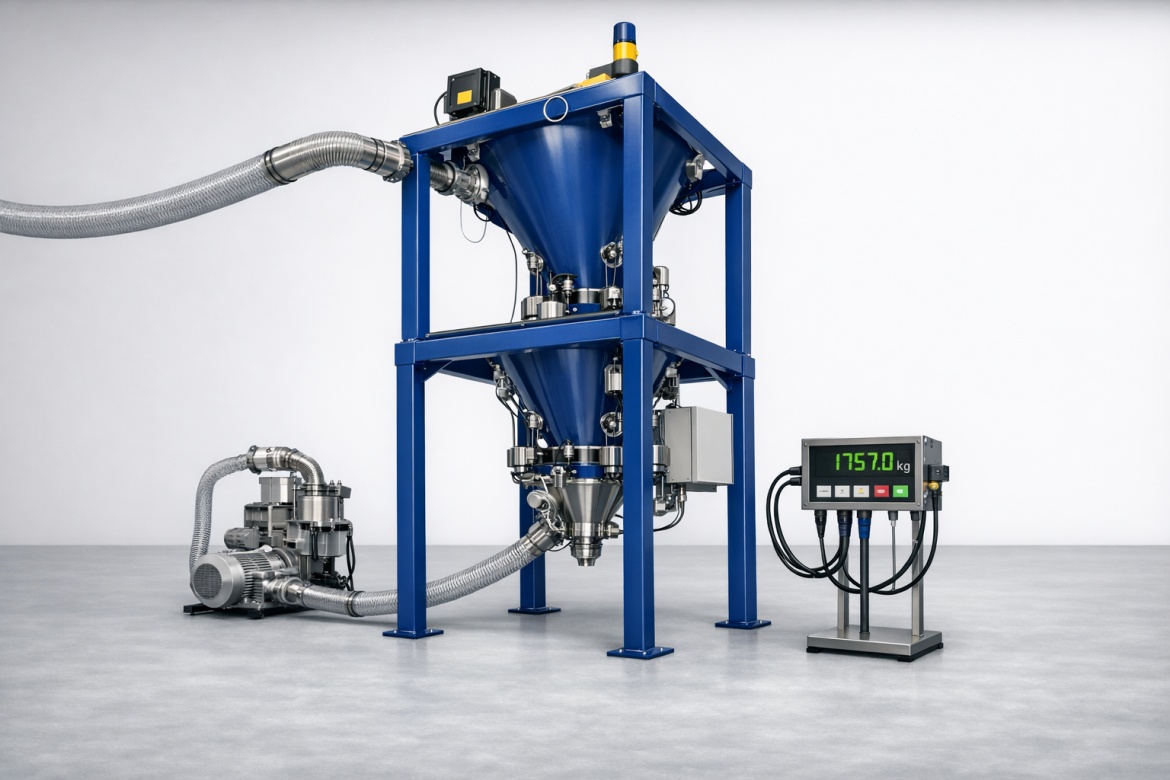
Bulk Material Weighing Vessels as Central Success Factors in Production Processes
Modern production demands maximum precision, efficiency, and traceability—especially when handling and dosing bulk materials. Application fields range from the food industry to chemicals and plastics or rubber production. The right weighing and dosing system is often the deciding factor for productivity, quality, and cost efficiency.
Custom weighing vessels as the key to process optimization
- Reliable dosing and weighing accuracy for a wide range of material properties
- Ensured process safety and batch integrity—even for challenging raw materials
- Adaptation to on-site conditions and customer requirements—from geometry to material selection
- Full functionality thanks to bespoke planning, manufacturing, and commissioning
From raw material to finished product: Every process is unique
The diversity of bulk materials presents machine and system builders with complex challenges. Different flow behaviors, stickiness, aggressiveness, or moisture sensitivity must all be considered during design. Precise configuration is essential for every weighing vessel: material selection, dimensions, discharge and shut-off systems, as well as testing and acceptance criteria must fit the process exactly.
Modern installations also address ATEX requirements for explosion-prone areas, especially where dust or gas mixtures are present. Thorough risk analyses and precisely adapted designs ensure maximum safety and reliability—even up to ST3 class and hybrid zones.
Precision through customization: Competitive advantages of tailored solutions
Compared to standard systems, bespoke solutions deliver maximum product quality and flexibility. Minimum and maximum working weights and tolerances are individually specified. Whether handling pasty, highly viscous, or difficult bulk materials like steel wool, a sophisticated weighing concept ensures consistent, reproducible results, regardless of material fluctuations or process conditions.
Focusing on actual customer requirements creates cost-efficiency. In many cases, individualized systems are even more compact and economical than standard machinery—especially if all trades are aligned to core processing needs.
Key application fields and innovations in weighing vessel technology
Major areas of application for custom-built weighing vessels are industrial mixing rooms in rubber and polymer processing, where maximum requirements for homogeneity and dosing precision apply. Integrated control systems ensure synchronized filling and emptying cycles as well as the monitoring of process parameters—even for variable production quantities in rapid cycles.
Digital solutions are becoming increasingly important: Networked sensors, continuous monitoring, and interfaces to Manufacturing Execution Systems (MES) help prepare systems for Industry 4.0. Each weighing and dosing step can be documented transparently—a key factor for quality management and traceability.
Practical tips for project planning and system integration
- Capture all relevant process parameters and raw material properties at the project planning stage
- Work with experienced specialists to speed up planning and implementation
- Prepare early for integration with existing installations
- Securely and thoroughly implement ATEX, CMK, CPK, or other special requirements
- Treat functional acceptance and initial commissioning as critical quality milestones
Conclusion: Process security through custom weighing vessels
Investing in a tailor-made weighing vessel solution pays off on every level—from production and quality assurance to cost-efficiency. Smart system design, coupled with a focus on material, weight, and process needs, delivers systems that generate real added value across their entire lifecycle.