

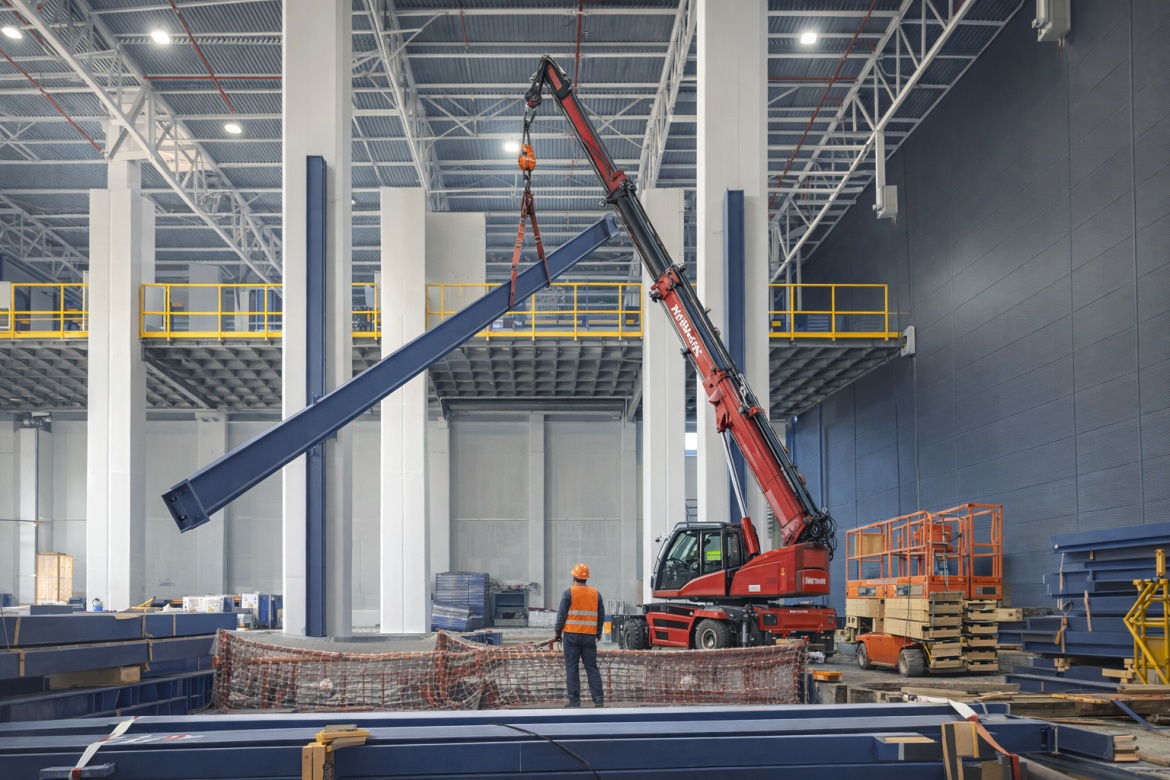
Customized Steel Structures: The Key to Enhanced Industrial Plant Efficiency
Steel construction is the backbone of modern industrial plants. While automation and process control are often in the spotlight, the potential of customized steel structures is frequently overlooked. Careful planning and execution of steel elements can decisively improve the efficiency and future-readiness of entire production lines.
Competitive Advantage through Tailor-Made Solutions
- Process Optimization: Adapted steel structures precisely support process flows – providing optimal placement for accesses, pipelines, and system components.
- Sustainability and Longevity: High-quality steel withstands even extreme industrial environments, resulting in lower maintenance and long-term costs.
- Flexible Expandability: Modular designs ensure that future modifications or expansions can be implemented easily and efficiently.
- Safety: Certified steel construction reliably protects people and machinery from unexpected loads or vibrations.
Planning as the Basis: From Concept to Realization
The efficiency and scalability of a plant are determined at the concept stage. Working with experienced industry specialists ensures that project-specific process data, load cases, and spatial conditions are analyzed in detail. The aim is to develop a framework tailored to the project’s technical and operational requirements.
In the plant environment, steel structures have evolved far beyond simple support frames. They now provide core functions, including supporting heavy dosing, weighing, or conveying systems, enabling access to multiple levels, or integrating insulation and safety features. This presents unique opportunities to make plants more compact, energy-efficient, and safe.
Practical Insights: Smooth Integration of Specialized Components
The benefits of customized steel structures are especially apparent in specialized plant engineering. Machines and modules—such as tanks, pumps, heaters, or conveying systems—require adjusted supports. Engineers rely on parametric planning to reflect various configuration options and facilitate future modifications.
Technical challenges such as explosion protection (ATEX), temperature influences, high vibrations, or the need for future expansions are taken into account early in the design of steel structures. Components are designed to withstand changing loads while remaining easy to maintain. Close coordination with dosing, weighing, and automation ensures minimal footprint and optimal accessibility.
Technology Trend: Digital Simulation and Production
Planning software and digital twins enable optimal design of steel structures—long before the first steel girder is fabricated. Virtual simulations identify and prevent collisions, load peaks, or weak points early on. This approach speeds up verification and documentation, which is especially important for clients in regulated industries such as food or chemicals.
State-of-the-art manufacturing technologies ensure that both custom and serial steel fabrications are delivered reliably and on schedule. Well-planned prefabrication and site logistics minimize downtime during installation.
The Path to Scalable Plants: Practical Recommendations
Looking ahead, it is crucial to focus on scalable, certified designs and sustainable materials in steel construction. Close collaboration between construction, process engineering, and automation is essential. Comprehensive expertise and digital tools are invaluable for transforming concepts into efficient, tailor-made steel structures.
Steel construction has evolved from an invisible supporter to a key value driver in the industrial plant supply chain. Early, careful planning of flexible and scalable structures is a vital investment in the future of production operations.