

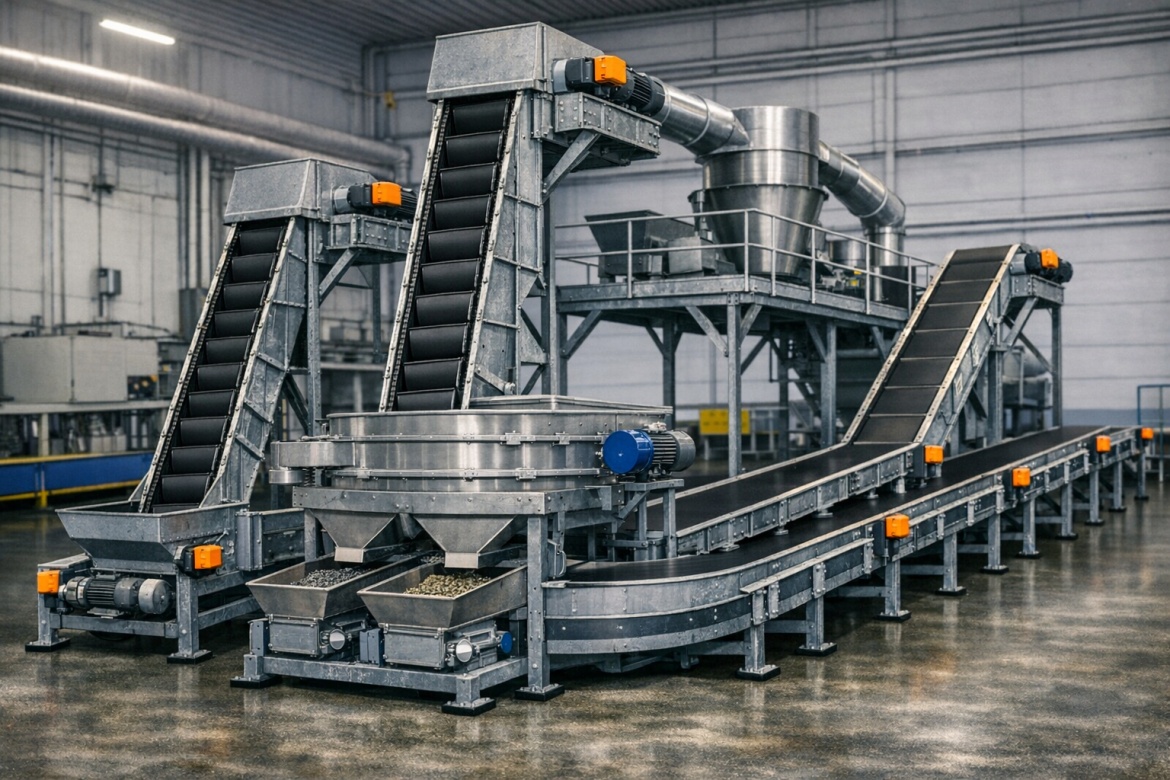
Tubular Chain Conveyors: The Underestimated Key Technology for Challenging Bulk Material Handling
Efficiency, flexibility, and operational reliability are critical to productivity and economic success in modern industry. Where conventional belt or bucket elevators reach their limits, tubular chain conveyors have emerged as the innovative solution for demanding material handling applications. Understanding their advantages and the nuances of proper system design unlocks substantial competitive potential.
Versatile Solutions Beyond Conventional Technology
- Complex layouts with tight-radius bends, inclines, and multiple floors
- Safe transport of abrasive, sensitive, or challenging bulk materials
- Enclosed, dust-tight, and hygienic design options
- Low energy consumption with minimal maintenance requirements
- Easily integrated into weighing, dosing, and processing lines
Technical Fundamentals and Key Advantages
The concept relies on a continuous chain with attached discs, gently conveying materials through sealed pipes. Depending on configuration, powders, granules, fibers, and even sticky or abrasive content are moved efficiently and with minimal product degradation. Long horizontal and vertical distances, plus intricate layouts, can be handled with ease. The systems are typically dust-tight and available in stainless steel or for specialized uses such as hygienic or ATEX-regulated environments.
Applications span from food and chemicals to plastics and rubber processing—anywhere maximum process safety and gentle handling are paramount.
Planning and Implementation: Customization Instead of Standardization
The ideal conveying system begins with detailed analysis: raw material properties and process requirements determine the choice of pipe diameter, chain type, and drive concept. Challenging tasks—such as bridging or abrasive materials—demand special solutions at critical points like transition to weighing or dosing. Design must minimize dead zones, support easy cleaning, and meet all safety and regulatory standards, as well as seamlessly integrate into entire process lines.
Experienced engineering specialists employ process expertise, feasibility studies, and simulations to deliver systems that deliver not just functionality, but add measurable business value.
Case Study: Efficient Conveying in Constrained Spaces
An international food processor needed to transfer difficult-to-handle materials from multiple building levels to a central weighing and mixing station—despite highly restricted space. The answer: a custom tubular chain conveyor, tailored to manage tight bends and vertical lifts, that operates automatically and links precisely to weighing and dosing controls. The result: enhanced production capacity and higher hygiene standards, all without major modification to existing infrastructure.
Such cases underscore a key advantage of custom-engineered systems: they maximize functionality, protect investment, and enable agile adaptation to new requirements.
Safety, Quality, and Digital Integration
Tubular chain conveyors can be designed to meet rigorous standards—including ATEX or GMP requirements. Condition monitoring, automated cleaning, and connections to manufacturing databases pave the way for digital transformation of conveyor operations. Meticulous coordination of system components reduces stoppages, material loss, and downtime. Modular, scalable systems support future upgrades and greater flexibility across the plant.
Conclusion: Tubular Chain Conveyors as Success Factors in Industrial Processes
For powders, granules, fibers, abrasive, or temperature-sensitive materials alike—selecting and specifying the right tubular chain conveyor system delivers lasting efficiency gains. Success is defined by holistic planning and strategic design, establishing technological benchmarks and delivering a sustainable edge in global competition.