

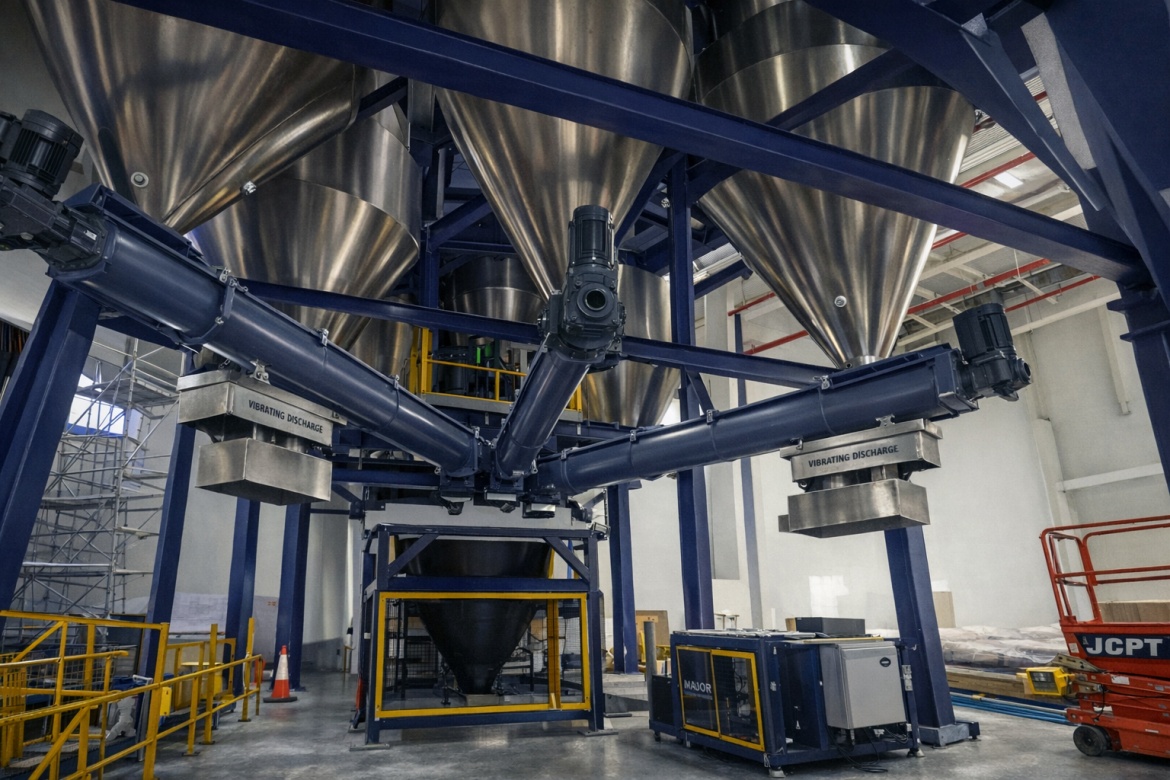
Screw Dosing Systems Are Revolutionizing Bulk Material Processes
In bulk material production, the quality of the dosing system directly impacts productivity, efficiency, and precision. While standard plants often reach technical or economic limits, tailor-made screw dosing systems deliver decisive advantages. These systems ensure secure feed of a wide range of raw materials—consistently and even with challenging substances.
Custom-designed screw dosing systems are key for efficient, reliable processing of bulk goods—especially with difficult-to-handle materials.
- Tailored adaptation to material and process requirements
- Single and twin screw setups for variable dosing capacities
- Optimal combination of capacity and accuracy
- Proven solutions for poor-flowing materials
- Maximum reliability and system availability
The Limits of Conventional Standard Solutions
Bulk materials are fundamental in countless production environments. However, dosing of sluggish, abrasive, or sensitive substances presents standard systems with severe challenges: material buildup, blockages, dosing inaccuracies, or product degradation are frequent issues. Practice has shown that all-purpose approaches seldom meet demanding requirements, despite advanced control technology.
Real-world projects illustrate that the flexible scalability achieved by tailored engineering—such as by B&K—yields crucial advantages, particularly with shifting product qualities and complex blends. Standardized machinery quickly faces limits when materials are not a perfect match for the mechanics.
Screw Dosing Systems: Construction and Functional Principles
The heart of modern bulk material dosing technology is the screw dosing system. Single screws are used for homogeneous, free-flowing substances, while twin screw systems address the toughest challenges. Combining large and small screws delivers high throughput in short cycles and simultaneously ensures high resolution and accuracy. This approach is especially valuable for precise recipes and batches.
As opposed to vibratory or pneumatic methods, the continuous discharge via a screw trough results in a consistent flow without segregation. Both geometry and material of the screw are meticulously matched to the bulk material, preventing caking or bridging.
Customized Solutions for Any Challenge
No raw material is the same. Poor flowability, high corrosion, or strict hygiene standards require specific adjustments. Many projects involve special geometries, unique surface treatments, or ATEX-compliant components to maximize process reliability and efficiency.
Through extensive testing, simulations, and feasibility studies, systems are developed that perform under actual process conditions. Alongside conveying technology, precise weighing integration remains in focus to minimize deviations.
Practical Tips for Planning and Implementation
- Analyze bulk material properties early: particle size, moisture, flowability
- Define process objectives precisely: cycle times, throughput, recipe accuracy
- Combine twin screws for high and fine dosing tasks
- Use pilot trials and test systems for validation
- Match screw and container materials to the handled bulk
Future Trends in Screw Dosing Technology
Technical advances are enabling ever more flexible solutions: Modular systems, sensors for real-time monitoring, and digitized maintenance boost efficiency. AI-based process control further allows self-learning adaptation of dosing parameters to raw material changes, minimizing downtime and maintenance.
The focus continues to be on individual process adaptation, maximum operational reliability, and ultimate product quality. As standard solutions reach their limits, custom screw dosing systems are set to further drive innovation in the bulk material industry.